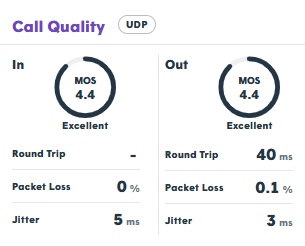
The Call Quality Widget evaluates the real-time integrity of a WebRTC session. By simulating an actual visit, it provides concrete metrics on how audio and video will behave under current network conditions.
Data Metrics & Quality Definitions
| Metric | Impact on Quality |
|---|---|
| MOS Score | Mean Opinion Score (1–5). A subjective overall quality rating. |
| Round Trip (RTT) | The time packets take to travel to the server and back. Lower is better. |
| Packet Loss | The % of data lost in transit. High loss leads to robotic audio and frozen video. |
| Jitter | Fluctuations in packet timing. High jitter causes "stuttering" media. |
MOS Score Breakdown
The MOS (Mean Opinion Score) is the most critical indicator of user satisfaction:
| 4.0 - 5.0 | Excellent |
| 3.0 - 3.9 | Good |
| 2.0 - 2.9 | Fair |
| 1.1 - 1.9 | Poor |
| 1.0 or less | Bad |
Diagnostic Insights
- Immediate Action: A MOS score rated "Poor" or "Bad" requires immediate network investigation. While other widgets suggest why the network might fail, this widget confirms that the user is currently experiencing degraded media.
- Ideal Performance: For high-fidelity exams (like stethoscope or otoscope exams), clinicians should strive for an Excellent or Good MOS score to ensure clinical accuracy.
Support Tip: If the MOS score is low but the Bandwidth Widget shows high capacity, the issue is likely latency (RTT) or jitter, often caused by distance from the server or unstable Wi-Fi—not a lack of raw speed.